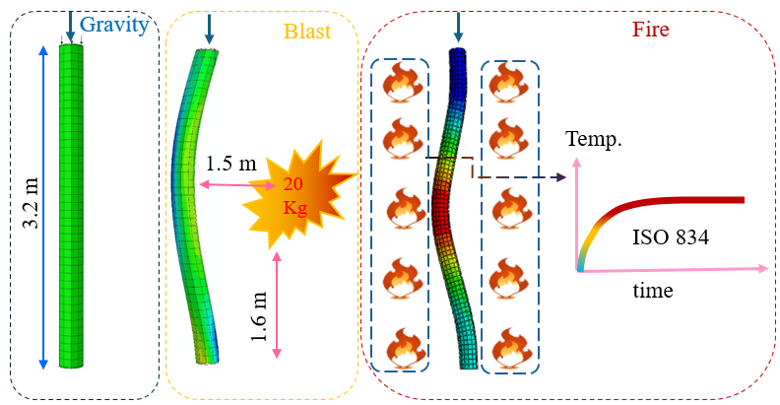
Numerical Simulation of Threat-Independent Progressive Collapse
Downloads
Downloads
Taylor, D.A., Progressive Collapse, Canadian Journal of Civil Engineering, 2, 1975, pp. 517-529.[CrossRef]
Ellingwood, B.R. and Leyendecker, E.V., Approaches for Design against Progressive Collapse, Journal of the Structural Division, 104(ST3), 1978, pp. 413-423.
Allen, D.E. and Schriever, W.R., Progressive Collapse, Abnormal Load, and Building Codes, Structural Failure: Modes, Causes, Responsibilities, Proceedings, American Society of Civil Engineers, New York, 1972.
Wibowo, H. and Lau, D.T., Seismic Progressive Collapse: Qualitative Point of View, Civil Engineering Dimension, Vol.11, No.1, 2009, pp. 8-14.
The U.S. General Service Administration (GSA), Progressive Collapse Analysis and Design Guidelines for New Federal Office Buildings and Major Modernization Projects, 2003.
The U.S. Department of Defence (DoD), Design of Buildings to Resist Progressive Collapse, Unified Facilities Criteria (UFC) 4-023-03, 2005.
Elvira, E., Mendis, P., Ngo, T., and Lam, N., Development of a Progressive Collapse Analysis Procedure for Concrete Frame Structures, Proceedings of the 18th Australasian Conference on the Mechanics of Structures and Materials, 1-3 December 2004, Perth, Australia, 2004, pp. 775-780.
de Witte, F.C. and Kikstra, W.P., Eds., DIANA Finite Element Analysis, User’s Manual: Release 9.1, TNO Building and Construction Research, Delft, The Netherlands, 2005.
Australian/New Zealand Standards, Structural Design Actions: Part 1: Permanent, Imposed and other Actions, AS/NZS 1170.1:2002, Standards Australia and Standards New Zealand, 2002.
Collins, M.P. and Poresz, A., Shear Strength for High Strength Concrete, Bull. No. 193-Design
Aspects of High Strength Concrete, Comite Euro-International du Beton (CEB), 1989, pp. 75-83.
Hordijk, D., Local Approach to Fatigue of Concrete, PhD Thesis, Delft University of Technology, 1991.
- Authors retain the copyright and publishing right, and grant the journal right of first publication with the work simultaneously licensed under a Creative Commons Attribution License that allows others to share the work with an acknowledgement of the work's authorship and initial publication in this journal.
- Authors are able to enter into separate, additional contractual arrangements for the non-exclusive distribution of the journal's published version of the work (e.g., post it to an institutional repository or publish it in a book), with an acknowledgement of its initial publication in this journal.
- Authors are permitted and encouraged to post their work online (e.g., in institutional repositories or on their website) followingthe publication of the article, as it can lead to productive exchanges, as well as earlier and greater citation of published work (See The Effect of Open Access).