Numerical Investigation of Seismic Responses of Fault-Crossing Segmental Water Conveyance Tunnel
Downloads
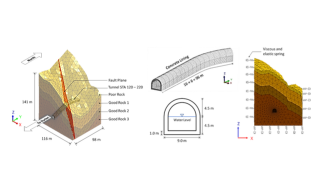
Tunnels are important infrastructures, but faults and internal water pressure can reduce their seismic performance. These risks are relevant in seismic regions including Indonesia. Although finite element methods are used to analyze tunnel behavior, models with continuous linings overestimate stresses, while the influence of segmental joints remains underexplored. This study investigates the seismic response of the Bener Dam diversion tunnel, Central Java, Indonesia, which crosses an inactive fault and uses segmental lining, using nonlinear time-history finite element analysis. Three scenarios were analyzed: presence versus absence of a fault, empty versus water-filled conditions, and continuous versus jointed linings. The results indicated that fault-crossing tunnels are most vulnerable to horizontal slip, especially under pulse-like earthquakes, with strains concentrated near faults. Water minimally affects deformation but increases internal stress, while segmental joints elevate peak strain yet localize damage. These findings highlighted the need to consider fault, water, and joint effects in seismic tunnel design.
Downloads
FHWA-NHI-10-034, Technical Manual for Design and Construction of Road Tunnels - Civil Elements, National Highway Institute, U.S. Department of Transportation, Federal Highway Administration, Washington, D.C., 2009, retrieved from https://www.fhwa.dot.gov/bridge/tunnel/pubs/nhi09010/tunnel_manual.pdf
Wang, J.N., Seismic Design of Tunnels, Parsons Brinckerhoff Inc., New York, 1993.
Wang, W.L., Wang, T.T., Su, J.J., Lin, C.H., Seng, C.R., and Huang, T.H., Assessment of Damage in Mountain Tunnels due to the Taiwan Chi-Chi Earthquake, Tunnelling and Underground Space Technology, 16(3), 2001, pp. 133–150, retrieved from https://doi.org/10.1016/S0886-7798(01)00047-5.
Wang, X., Jin, X., Wang, P., and Yang, Z., Parallel Dynamic Analysis of a Large-Scale Water Conveyance Tunnel under Seismic Excitation using ALE Finite-Element Method, Applied Sciences, 6(2, Art. no. 2, 2016, retrieved from https://doi.org/10.3390/app6020036.
Lyu, D., Yu, C., Ma, S., and Wang, X., Nonlinear Seismic Response of a Hydraulic Tunnel Considering Fluid-Solid Coupling, Mathematical Problems in Engineering, 2018(1), 2018, p. 9608542, retrieved from https://doi.org/10.1155/2018/9608542.
National Earthquake Study Center of Indonesia, Earthquake Sources and Hazards Maps of Indonesia 2017, Ministry of Public Works and Public Housing of the Republic of Indonesia, South Jakarta, Indonesia, 2017. (In Indonesian).
Ranjbar, G.H., Shahriar, K., and Ahangari, K., Effect of Segmental Joint on Internal Forces in Tunnel Lining under Seismic Loading by Numerical Method, Journal of Mining and Environment, 11(3), 2020, pp. 737-751, retrieved from https://doi.org/10.22044/jme.2020.8979.1785.
Trad, R., Mroueh, H., Bian, H., and Cormery, F., Synthesis of Numerical Methods for the Design of Segmental Tunnel Lining, MATEC Web of Conferences, 295, 2019, p. 03008, retrieved from https://doi.org/10.1051/matecconf/201929503008.
Li, R., Yuan, Y., and Zhao, X., Seismic Response of Tunnel across Inactive Fault: Numerical Analysis, IOP Conference Series: Earth and Environmental Science, 861(5), 2021, p. 052031, retrieved from https://doi.org/10.1088/1755-1315/861/5/052031.
Shahidi, A.R. and Vafaeian, M., Analysis of Longitudinal Profile of the Tunnels in the Active Faulted Zone and Designing the Flexible Lining (for Koohrang-III Tunnel), Tunnelling and Underground Space Technology, 20(3), 2005, pp. 213–221, retrieved from https://doi.org/10.1016/j.tust.2004.08.003.
Bagio, C.A., Rifa’I, A., and Ismanti, S., Tunnel Stability in Fault Zone Base on 3D Numerical Simulation, IOP Conference Series: Earth and Environmental Science, 871(1), 2021, p. 012052, retrieved from https://doi.org/10.1088/1755-1315/871/1/012052.
Amrei, S.A.R., Vahdani, R., Gerami, M., and Amiri, G.G., Correlation Effects of Near-Field Seismic Components in Circular Metro Tunnels: A Case Study - Tehran Metro Tunnels, Shock and Vibration, 2020(1), 2020, p. 3016465, retrieved from https://doi.org/10.1155/2020/3016465.
Jiao, H., Du, X., Zhao, M., Huang, J., Zhao, X., and Ouyang, W., Nonlinear Seismic Response of Rock Tunnels Crossing Inactive Fault under Obliquely Incident Seismic P Waves, Journal of Earth Science, 32(5), 2021, pp. 1174–1189, https://doi.org/10.1007/s12583-021-1483-2.
Ghobakhloo, E., Pourlak, M., and Razmkhah, A., Seismic Waves Scattering Impact through Tunnel Excavation on Adjacent Monuments Subjected to Far Field Earthquakes, Civil Engineering Dimension, 17(2), 2015, pp. 59–66, retrieved from https://doi.org/10.9744/ced.17.2.59-66.
Pawestri, M.T., Sujono, J., Istiarto, I., Flood Hazard Mapping of Bogowonto River in Purworejo Regency, Central Java Province, Journal of the Civil Engineering Forum, 2(3), 2016, pp. 129-140, retrieved from https://doi.org/10.22146/jcef.24348.
Salaamah, A.F., Fathani, T.F., and Wilopo, W., Correlation of P-wave Velocity with Rock Quality Designation (RQD) in Volcanic Rocks, Journal of Applied Geology, 3(2), 2019, p. 11, retrieved from https://doi.org/10.22146/jag.48594.
Sasangka, D.J., Insani, D., and Indrawan, I.G.B., Engineering Geology Model of Bener Dam Diversion Tunnels in Geological Risk Disaster Mitigation, Jurnal Geofisika Eksplorasi, 6(3), 2020, pp. 205–215, retrieved from https://doi.org/10.23960/jge.v6i3.95.
Triristanto, E.R., Engineering Geological Evaluation and Deformation Analysis of the Bener Dam Diversion Tunnel, Purworejo Regency, Central Java Province, Master Thesis, Gadjah Mada University, Yogyakarta, Indonesia, 2023. (In Indonesian).
Primadika, R.A., Fathani, T.F., and Faris, F., Modal Analysis and Ground Motion Modification for Tunnel Seismic Design in Fault Zone, Proceedings of the Simposium Nasional Teknologi Infrastruktur, Yogyakarta, Indonesia, 2025.
Marinos, P.G., Marinos, V., and Hoek, E., Geological Strength Index (GSI). A Characterization Tool for Assessing Engineering Properties for Rock Masses, In: Ollala, C., Perucho, Á., Romana, M., Editors, Underground Works under Special Conditions: Proceedings of the ISRM Workshop W1, Madrid, Spain, 6-7 July 2007, Taylor & Francis, 2007, retrieved from https://doi.org/10.1201/NOE0415450287.
Dharmawan, A.G., Evaluation of Engineering Geological Conditions and Stability Analysis of the Bener Dam Diversion Tunnel, Purworejo Regency, Central Java Province, Master Thesis, Gadjah Mada University, Yogyakarta, Indonesia, 2019. (In Indonesian).
Bagio, C.A., Analysis of the Effect of Fault Existence on Tunnel Stability Based on 3D Numerical Simulation, Master Thesis, Gadjah Mada University, Yogyakarta, Indonesia, 2021. (In Indonesian).
Hoek, E., Carter, T.G., and Diederichs, M.S., Quantification of the Geological Strength Index Chart, Proceedings of the 47th U.S. Rock Mechanics/Geomechanics Symposium, 2013, p. ARMA-2013-672.
Hoek, E., Kaiser, P.K., and Bawden, W.F., Support of Underground Excavations in Hard Rock, 1995.
Narimani, S., Davarpanah, S.M., and Vásárhelyi, B., Estimation of the Poisson’s Ratio of the Rock Mass, Periodica Polytechnica Civil Engineering, 68(1), 2023, pp. 274–288, retrieved from https://doi.org/10.3311/PPci.22689.
Hoek, E. and Diederichs, M.S, Empirical Estimation of Rock Mass Modulus, International Journal of Rock Mechanics and Mining Sciences, 43(2), 2006, pp. 203–215, retrieved from https://doi.org/10.1016/j.ijrmms.2005.06.005.
Hoek, E., Carranza-Torres, C., and Corkum, B., Hoek-Brown Failure Criterion - 2002 Edition, Proceedings of the NARMS-TAC Conference, Toronto, 2002.
Marinos, P. and Hoek, E., GSI: A Geologically Friendly Tool for Rock Mass Strength Estimation, Proceedings of the ISRM International Symposium, 2000.
Sheorey, P.R., A Theory for In Situ Stresses in Isotropic and Transversely Isotropic Rock, International Journal of Rock Mechanics and Mining Sciences & Geomechanics Abstracts, 31(1), 1994, pp. 23–34, reterieved from https://doi.org/10.1016/0148-9062(94)92312-4.
Leijon, B. and Conterra, A.B., Mechanical Properties of Fracture Zones, Swedish Nuclear Fuel and Waste Management Co., Stockholm, 1993, retrieved from https://skb.se/publikation/9263/TR93-19_OCR.pdf.
Rocscience Inc., Estimating Joint Stiffness, accessed: Feb. 01, 2025, retrieved from https://static.rocscience.cloud/assets/verification-and-theory/RS2/RS2-Estimating-Joint-Stiffness.pdf.
Hoek, E., Strength of Jointed Rock Masses, Géotechnique, 33(3), 1983, pp. 187–223, retrieved from https://doi.org/10.1680/geot.1983.33.3.187.
Wilson, E.L., The 2005 Version of Three Dimensional Static and Dynamic Analysis of Structures, 2005, retrieved from https://edwilson.org/bookshelf/2005ver.
Lestari, Y., Istiarto, I., and Sujono, J., Performance of Dodging Channels and Cofferdams against Flood Flows in the Construction of Bener Dam, Inersia: Jurnal Teknik Sipil dan Arsitektur, 19(2), Art. no. 2, 2023, retrieved from https://doi.org/10.21831/inersia.v19i2.58182.
Xiao, X., Wang, J., Wang, J., and Zhou, H., Determination of Local Stiffness for the Joint of Tunnel Lining in the Simulation, Revista Internacional de Métodos Numéricos para Cálculo y Diseño en Ingeniería, 40(2), 2024, retrieved from https://doi.org/10.23967/j.rimni.2024.03.005.
FHWA-HRT-06-106, Design and Evaluation of Jointed Plain Concrete Pavement with Fiber Reinforced Polymer Dowels, U.S. Department of Transportation, Federal Highway Administration, Washington, D.C, 2009, retrieved from https://www.fhwa.dot.gov/publications/research/infrastructure/pavements/06106/chap6.cfm
SNI 8460:2017, Geotechnical Design Requirements, National Standardization Agency of Indonesia, 2017. (In Indonesian).
SNI 8899:2020, Procedures for Selecting and Modifying Surface Ground Motion for Earthquake-Resistant Building Planning, National Standardization Agency of Indonesia, 2020. (In Indonesian).
Wyering, L., Villeneuve, M., and Wallis, I., The Effects of Hydrothermal Alteration on Mechanical Rock Properties of the Andesite Breccia and Tahorakuri Formation from the Ngatamariki Geothermal Field, New Zealand and Empirical Relations between Rock Strength and Physical Properties, Proceedings of the 34th New Zealand Geothermal Workshop, Auckland, New Zealand, 2012.
The Pacific Earthquake Engineering Research Center, PEER Ground Motion Database - PEER Center, accessed: Sep. 04, 2025, retrieved from https://ngawest2.berkeley.edu/.
Mazzoni, S., NGA-Subduction Portal: Ground-motion Record Selection and Download, The B. John Garrick Institute for the Risk Sciences, 2022, retrieved from https://doi.org/10.34948/N3D59V.
He, Y., Li, S., Wei, Y., and Xie, L., A Novel Strong Ground Motion Duration to Reduce Computation Time of Structural Time History Analysis, Soil Dynamics and Earthquake Engineering, 164, p. 107641, 2023, retrieved from https://doi.org/10.1016/j.soildyn.2022.107641.
Arias, A., Measure of Earthquake Intensity, in: Hansen, R.J., Editor, Seismic Design for Nuclear Power Plants, Massachusetts Institute of Technology Press, 1970, pp. 438–83, retrieved from https://www.osti.gov/biblio/4167721.
Earthquake Engineering Research Group INHA University, PRISM - Program for Earthquake Response Spectra, accessed: Jun. 26, 2025, retrieved from https://sem.inha.ac.kr/prism_2021/index.htm.
Midas IT Co., Interface, accessed: May 04, 2025, retrieved from https://manual.midasuser.com/en_common/gts%20nx/150/GTS_NX/Mesh/Property,Coordinate,Function/Material/General_Material(Behavioral_properties)/Interface.htm.
Midas IT Co., Transmitting, accessed: May 08, 2025, retrieved from https://manual.midasuser.com/en_common/feanx/340/FEA_NX/Dynamic_Analysis/Boundary/Transmitting.htm.
Kardoutsou, V., Taflampas, I., and Psycharis, I.N., A New Pulse Indicator for the Classification of Ground Motions, Bulletin of the Seismological Society of America, 107(3), 2017, pp. 1356–1364, https://doi.org/10.1785/0120160301.
Seismosoft, SeismoSignal - Strong-Motion Data Processing, accessed: Jan. 29, 2026, retrieved from https://seismosoft.com/products/seismosignal/.
Chen, P., Geng, P., Chen, J., and Gu, W., The Seismic Damage Mechanism of Daliang Tunnel by Fault Dislocation during the 2022 Menyuan Ms6.9 Earthquake based on Unidirectional Velocity Pulse Input, Engineering Failure Analysis, 145, 2023, p. 107047, retrieved from https://doi.org/10.1016/j.engfailanal.2023.107047.
Liel, A. and Champion, C., The Effect of Near-Fault Directivity on Building Seismic Collapse Risk, U.S. Geological Survey, Feb. 2010, retrieved from https://earthquake.usgs.gov/cfusion/external_grants/reports/G10AP00041.pdf.
Copyright (c) 2026 Ridhwan Afnan Primadika, Teuku Faisal Fathani, Fikri Faris

This work is licensed under a Creative Commons Attribution 4.0 International License.
Authors who publish with this journal agree to the following terms:- Authors retain the copyright and publishing right, and grant the journal right of first publication with the work simultaneously licensed under a Creative Commons Attribution License that allows others to share the work with an acknowledgement of the work's authorship and initial publication in this journal.
- Authors are able to enter into separate, additional contractual arrangements for the non-exclusive distribution of the journal's published version of the work (e.g., post it to an institutional repository or publish it in a book), with an acknowledgement of its initial publication in this journal.
- Authors are permitted and encouraged to post their work online (e.g., in institutional repositories or on their website) followingthe publication of the article, as it can lead to productive exchanges, as well as earlier and greater citation of published work (See The Effect of Open Access).